


A segment LCD is the cheapest way to put legible numbers, icons and status flags on a device: one custom glass, a few microamps, and a display that keeps working after a decade in the field. It is also the component most often specified twice — once on the drawing, and again after the first samples come back grey, ghosted, or unreadable at an angle. Most of that rework traces back to one decision made too early: the LCD type. This guide compares TN, HTN, STN, FSTN and VA segment LCDs on contrast, viewing angle, response, duty and cost, and shows which one fits which application.
Quick answer: which segment LCD type do you need?
| Type | Cell structure |
Typical background |
Contrast | Viewing angle |
Response | Typical duty |
Relative cost |
Typical applications |
|---|---|---|---|---|---|---|---|---|
| TN | 90° twisted nematic | Grey/silver with black characters (positive) | Medium | Narrow | Fast | 1/1–1/4 | Low | Thermostats, multimeters, remote controls |
| HTN | 100–120° high twist | Pale yellow / grey-green | Medium-high | Narrow to medium | Fast | 1/2–1/4 | Low-medium | Small appliances, phones, toys |
| STN | 180–270° super twist | Yellow-green with black, or blue with white | High | Medium | Slower when cold | 1/8–1/32 | Medium | Electricity, water and gas meters; instrumentation |
| FSTN | STN + retardation film | Black on white / white on black | Very high | Medium-wide | Slower when cold | 1/8–1/32 | Medium-high | Automotive clusters, medical devices, industrial panels |
| VA | Vertically aligned, no twist | Black with white characters | Highest | Wide | Fast | Low to medium, any multiplex | High | Smart appliance panels, premium instruments |
Figures are typical industry ranges, not a specification. Confirm against the supplier’s datasheet — fluid formulation changes temperature and contrast performance significantly within the same type.
One-line version: few segments, tight budget, indoor use — TN; many segments — STN; a black-and-white face with a backlight — FSTN; a premium look — VA. HTN sits between TN and STN and is worth sampling only when TN contrast fails short but STN cannot be justified.
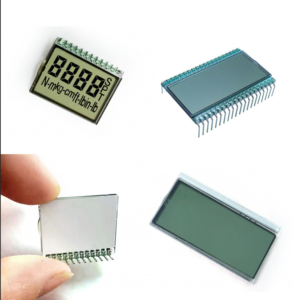
Four segment LCD glasses: polariser and fluid choice set the background colour and the positive/negative mode
The five segment LCD types, one by one
TN: the low-cost workhorse
TN (twisted nematic) twists the liquid crystal 90° between the two glasses and switches light with crossed polarisers. It is the fastest, simplest and cheapest segment LCD, and wide-temperature fluid versions still run in outdoor meters. The limits are equally clear: medium contrast, a narrow viewing cone — commonly quoted around ±30–45° — and a practical duty ceiling near 1/4, beyond which crosstalk and ghosting appear.
What this means for buying: for static or low-duty readouts viewed close up on a budget, TN is still the default. Once the artwork passes a few dozen segments, price STN before you commit.
HTN: the middle step
HTN (high twisted nematic) raises the twist to 100–120°, buying a modest gain in contrast and viewing angle for a small cost step. Its position is awkward — less contrast than STN, less price advantage than TN — so it mostly appears in small appliances and telephones as a cost-down option rather than a first choice.
What this means for buying: if TN samples look washed out but STN breaks the budget, ask for an HTN comparison build. Do not plan a new design around it.
STN: the workhorse for high segment counts
STN (super twisted nematic) lifts the twist to 180–270°, which steepens the electro-optic curve: higher contrast and far more multiplexing headroom, with 1/8 to 1/32 duty routine. The yellow-green panels covering electricity, water and gas meters are almost all STN. The trade-off is slower response, which degrades further in the cold — characters smear in cold stores and outdoor winter installations — plus a background that reads yellow-green or blue rather than neutral.
What this means for buying: if the artwork runs to hundreds of segments and needs multiplexed drive, STN is the default. If the product is installed outdoors, write a low-temperature response test into sample approval — not a field complaint later.
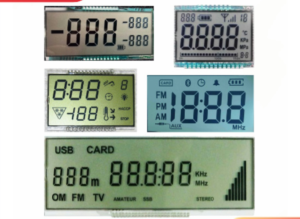
FSTN: a black-and-white face with contrast
FSTN (film-compensated STN) adds a retardation film that corrects the yellow-green background to black and white and lifts contrast further; built as a negative display with a backlight, it reads close to a monochrome LCD module. The black-and-white segment panels on automotive clusters, medical devices and industrial panels are FSTN. The film adds a lamination step; response stays at STN level — compensation film fixes colour balance and contrast, not cold-weather smearing.
What this means for buying: when the brand requires a neutral black-and-white face, specify FSTN. Do not expect it to fix response time — that is a fluid decision, not a film decision.
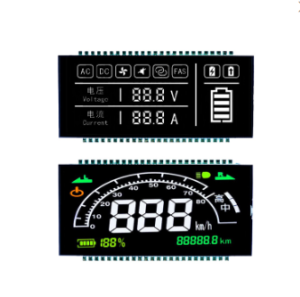
Automotive cluster segment LCD: negative black background plus high-brightness backlight is the classic FSTN/VA combination
VA: the closest thing to black glass
VA (vertically aligned) does not rely on twist. With no field applied, the molecules stand perpendicular to the glass and the panel reads black; when driven they tilt and the segment appears. The result is the highest contrast of the five, the deepest black and the widest cone — front and side views barely differ. That is why VA turns up on smart locks, coffee machines and thermostat panels, where appearance sells the product. It carries the highest unit price of the five, and a negative VA display essentially requires a backlight, so backlight cost and power draw belong in the comparison.
What this means for buying: in consumer products where the display is a selling point, the VA premium buys conversion. In purely functional instruments with no backlight budget, it buys contrast nobody sees.
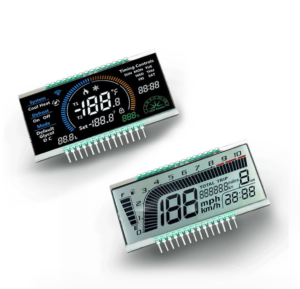
Smart appliance panel: VA negative display with colour backlight, close to a small colour screen in appearance
Viewing angle: what actually happens off-axis
Two things are being specified at once: the cone — how far off-axis the readout stays legible — and the viewing direction, either 6 or 12 o’clock, which is the direction of highest contrast. The direction is fixed at tooling and cannot be changed after delivery. That single constraint causes more field complaints than any other segment LCD parameter.
- TN: contrast falls fastest off-axis; characters turn grey and the background washes out. Typical cone is around ±30–45°. Fit a 12 o’clock panel in a benchtop unit and the operator looking down sees a grey rectangle.
- STN: the background darkens and the panel dims off-axis, but characters stay readable; the falloff is gentler than TN.
- FSTN: the compensation film holds black-and-white balance better off-axis, so grey-out is milder than STN.
- VA: black level and contrast stay stable across the cone, which is the root reason it has the widest usable angle of the five.
What this means for buying: fix the enclosure first, then the panel. Wall-mounted means 12 o’clock; benchtop or dashboard viewed from above means 6 o’clock. If you are unsure, have both directions sampled and judged inside the real housing — not on a desk under office lighting.
Cost: unit price is not the number to compare
The unit price ladder runs TN < HTN < STN < FSTN < VA, but landed good-unit cost usually reorders it once four items are counted:
- Tooling (NRE) and artwork complexity. A custom segment LCD requires tooling, and NRE is driven by segment count, glass outline and ITO routing difficulty — not by type. Simplifying artwork by 20% can save more than dropping down one type.
- Backlight consequences. Positive transfective or reflective panels can run without a backlight; negative FSTN and VA are effectively unreadable without one, and the backlight, assembly time and power draw all count. “VA is expensive” weakens considerably in a product that needed a backlight anyway.
- Driver cost. A 1/4-duty TN can be driven from ordinary I/O or a small driver; 1/16 duty and above need an MCU with an LCD controller or a dedicated driver IC. That BOM delta belongs in the display comparison, not in a separate line item.
- Failure and returns. A standard STN in an outdoor product generates smearing complaints that cost far more than the wide-temperature fluid would have at the quote stage.
Rule of thumb: cost the project over its life, not the panel per piece.
Four specification mistakes we see most
- TN on a high segment count. Duty cannot be pushed, characters brighten unevenly and edge segments ghost. Quoting TN against dense artwork is pre-paid rework.
- Negative display without a backlight. Black FSTN or VA is effectively unreadable unlit. “A black background saves power” is not a thing.
- Reusing the previous viewing direction. When the product moves from benchtop to wall mount, the panel greys out — and the direction was fixed at tooling.
- One temperature figure. Operating and storage temperature are separate specifications. An outdoor product missing the storage low limit can fail on its first cold start.
FAQ
Segment LCD or character module (1602/2004)?
If the graphics are yours — dials, custom icons, unusual characters — use a custom segment LCD. If the content is standard ASCII and you would rather not pay for tooling, use a character or graphic LCD module. They are separate product lines and can be quoted in parallel.
How can I tell TN from STN by eye?
Look at the background: a TN positive is usually grey or silver with black characters, while STN is typically yellow-green with black, or blue with white. Then tilt the panel — TN loses contrast faster. The datasheet settles it.
Can a segment LCD show colour?
Colour comes from the backlight, printed colour blocks or a colour film — cosmetic colour, not full colour. For photographic colour or animated graphics, evaluate a TFT display instead.
What is the MOQ and sample process?
Send a drawing or a sample unit — reverse engineering is fine — and we can quote from 100 pcs. Sample and production lead times depend on artwork complexity and are confirmed on the quotation.
Send the PDF or AutoCAD file, or photos of the #assembly. Our engineers will tell you which type — TN, STN, FSTN or VA — actually fits the application before you pay for tooling. See the custom segment LCD page or contact us.
