


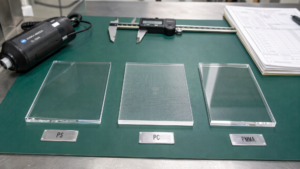
Light guide plate material selection is usually settled on page one of the BOM, long before anything fails in the field. One optical design can pass qualification on three of these four materials and fail on the fourth. This guide compares them on the constraints that decide the outcome.
|
4
Materials compared
|
3
Failure modes driven by material
|
2
RFQ numbers that prevent most of them
|
- Quick answer by application
- What material actually controls
- The four candidates at a glance
- Comparison, dimension by dimension
- Thermal and UV: where the cheap option fails
- Selection by application
- Cost per unit vs lifetime cost
- Three mistakes
- FAQ
Quick answer by application
Starting material by application profile. Validate against your own operating temperature before committing.
| Application profile | Starting material |
Why |
|---|---|---|
| Consumer / indoor, life under 3 years, cost-led | PS | Lowest piece price; workable while thermal load stays low |
| Instrument, HMI, appliance, 5–10 year target | PMMA | Highest transmission of the four, slow yellowing |
| Sealed housing, high ambient, vibration in spec | PC | Highest heat deflection and toughness of the plastics |
| High brightness, harsh environment, long life | Glass | Negligible yellowing and creep; higher cost and weight |
What light guide plate material actually controls
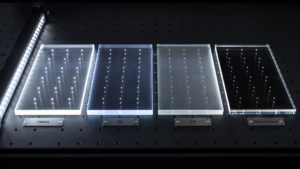
A light guide plate is not a passive plastic part. It is the optical engine of an edge-lit backlight: LEDs inject light at the edge, the plate spreads it, and extraction features release it toward the diffuser.
Three properties decide first-light performance. A fourth decides what happens in year three.
- Refractive index sets the internal reflection angle — how much light couples in and how far it travels before extraction.
- Transmission sets how much survives the trip to the diffuser.
- Dimensional stability sets whether the extraction pattern still aligns with the LEDs after an hour at temperature.
- Aging sets whether the unit still meets its color spec after two years of heat and short-wavelength light.
Change material and you change all four at once. The same CAD file in a different resin produces a different backlight, which is why a plate cannot be re-sourced as a drop-in substitute.
The four candidate materials at a glance
Candidate materials for edge-lit light guide plates. Typical industry ranges, not specifications — confirm against the supplier’s grade datasheet.
| Dimension | PMMA (acrylic) | PC (polycarbonate) | PS (polystyrene) | Glass |
|---|---|---|---|---|
| Light transmission | Highest of the plastics | Good, slightly below PMMA | Good when new; drops with age | Very high |
| Refractive index | ~1.49 | ~1.58 | ~1.59 | ~1.47–1.52 |
| Heat deflection | Moderate | Highest of the plastics | Lowest | Highest |
| Impact toughness | Brittle | Tough | Brittle | Brittle but hard |
| Yellowing (heat + UV) | Slow | Faster under UV | Fastest | Negligible |
| Moisture uptake / creep | Moderate | Low | Low | Negligible |
| Piece cost | Medium | Medium-high | Low | High |
| Tooling and processing | Mature | Drying, higher melt temp | Mature, cheapest | Cutting and polishing |
Two rows do most of the work. Heat deflection decides whether the plate stays flat in a sealed housing; yellowing decides whether the display still meets its color spec in year three. A material that wins on transmission but loses on either one will not survive qualification.
Light guide plate material comparison, dimension by dimension
Optical efficiency
PMMA usually delivers the highest transmission of the three plastics, which is why it dominates small and mid-size backlights where every lumen counts. PC’s higher refractive index changes the coupling geometry: it can improve extraction in a well-tuned design, but a pattern copied unchanged from PMMA often loses brightness.
Thermal behavior
In a sealed enclosure with LEDs running continuously, internal temperature commonly runs 15–20 °C above ambient at the LED edge — measure yours rather than estimate. PS softens earliest and can creep, bowing toward the diffuser and producing a visible bright band. PC tolerates the highest temperature of the plastics. Glass stays effectively unchanged.
UV and aging
With short-wavelength LEDs, or a display that sees daylight through a clear window, yellowing becomes a color-shift problem rather than a cosmetic one. PS degrades fastest, PMMA slowly. PC is more UV-sensitive than PMMA and usually needs a stabilized grade or a UV-blocking layer.
Mechanical and assembly
PC’s toughness matters in handheld and portable units where drop and vibration are specified. PMMA and PS crack under point loads, so screw bosses and frame clips have to be designed around them rather than into them.
Thermal and UV behavior: where the cheap option fails
The failure is rarely sudden. It is a slow drift that arrives as a complaint: “the screen looks yellow” or “there is a bright stripe along the bottom”.
Three mechanisms account for most field returns:
- Yellowing. Chain scission changes the absorption spectrum, so blue output drops first and the white point shifts warm.
- Creep and bow. Sustained heat plus frame spring force deforms the plate toward the diffuser, changing coupling at the LED entrance.
- Haze drift. Micro-cracks raise scattering, lowering peak brightness and making the extraction pattern visible as faint texture.
PS vs PMMA light guide plate yellowing
Side by side, the difference is rate, not direction. Both yellow, but PS reaches an unacceptable color shift far sooner at the same temperature and LED spectrum. If your service-life target runs past the warranty, that gap is the one to price in.
All three mechanisms accelerate with temperature, and most qualification tests run at the convenient temperature rather than the real one.
Light guide plate material selection by application
LED backlight material selection for a medical display
The constraint is color stability over service life, because a shifted white point can invalidate a visual reading. UV-stabilized PMMA is the common choice for small and mid-size units; glass suits sealed housings where weight is not critical. We do not recommend PS here regardless of cost pressure. Build options are covered under custom LED backlight units.
Industrial HMI and instrumentation
Wide ambient range and continuous operation dominate. PC handles the thermal load better; PMMA remains viable in vented enclosures or at low duty cycle. The failure to watch is bow, not yellowing.
Appliances and consumer units
Cost and cosmetics decide. PS is workable when thermal load is low and service life is short. PMMA is the safer middle. For anything that sits in sunlight, UV stabilization matters more than the base resin.
Glass light guide plate for harsh environment
Outdoor, high humidity, wide temperature. Glass removes the plastic yellowing variable, at the cost of weight, handling fragility and a different extraction process. We recommend it when the alternative is repeated field replacement.
Light guide plate material cost per unit vs lifetime cost
Piece price ranks the four materials in one order. Total cost of ownership often ranks them in another.
- Piece price rises from PS to PMMA to PC to glass. On a small plate the PS-to-PMMA spread sits inside the noise of the whole BOM.
- Tooling and process favor PMMA and PS. PC adds drying, higher melt temperature and warp-related loss. Glass removes injection tooling but adds cutting and handling.
- Yield and rework often erase the piece-price difference. For example, a material warping at 3% scrap costs more than one costing more per part and running at 0.5%.
- Field failure is the largest term and the least visible in a quote — one to two orders of magnitude above the plate itself.
That is the part of light guide plate material cost per unit a quotation rarely shows: the number is per good unit delivered, not per part shipped.
Three mistakes in light guide plate material selection
1. Treating material as a drop-in substitution
Re-sourcing a qualified plate in a “similar” resin without re-running the simulation. The CAD file is identical, so the sample looks right at first light; the color shift appears after thermal cycling. Correction: re-simulate the extraction pattern and re-run the thermal test.
2. Qualifying at room temperature
Incoming inspection usually runs at 25 °C because it is convenient. Every failure mode above is temperature-driven, so the test passes and the field fails. Correction: qualify at the maximum internal temperature the housing will reach, measured rather than estimated.
3. Specifying grade by resin family
“PMMA” covers optical grades, general-purpose grades and recycled content with materially different transmission and aging. Correction: name the grade and key values on the drawing, and require the supplier to declare the grade on the certificate of analysis.
FAQ
+PMMA vs PC light guide plate: which one should I choose?PMMA transmits more light and yellows more slowly under UV, which suits small and mid-size displays with moderate heat. PC tolerates higher temperature and impact better, which suits sealed, high-load or portable units. The deciding variable is the internal temperature of your enclosure, not the resin’s reputation.
+Does a cheaper light guide plate material save money?Only if the thermal load and lifetime are genuinely low. PS has the lowest piece price but degrades fastest under heat and UV, so the saving is usually repaid in yield loss or field returns.
+Why does a light guide plate turn yellow?Chain scission under heat and short-wavelength light changes the absorption spectrum, so blue output drops first and the white point shifts warm. PMMA resists this longer than PS. PC is more UV-sensitive and normally needs a stabilized grade. Glass does not yellow.
+When should I choose a glass light guide plate for a harsh environment?When the application cannot tolerate color drift or dimensional change over life: high brightness, outdoor or high-humidity conditions, or a long service life where field replacement is expensive. The trade-offs are weight, handling fragility and a different extraction process.
+Can I keep the same design if I change material?No. Refractive index, transmission and thermal expansion all change, so the extraction pattern must be re-simulated and the unit re-qualified at operating temperature. A sample that looks correct when cold is not evidence of a valid substitution.
If drift is your concern rather than material choice, our luminance uniformity test method shows how we quantify it before and after aging.
Send your display size, thickness limit and operating environment
We reply with a material recommendation, the reasoning behind it, and a sample evaluation plan.
