

A COB LCD module (chip on board) bonds the driver IC as a bare die directly onto the PCB and seals it under epoxy. Buyers often spec resolution, pin count and price — but what decides how long the module survives inside the end product is its material stack: the glass type, the epoxy compound, the PCB grade, the backlight scheme and the connector style. This guide walks through the stack layer by layer, weighs the advantages against the limits, and closes with material recommendations by application.
What “COB” means: chip on board vs COG vs FOG
COB (chip on board) means the bare IC die is wire-bonded onto the PCB and then encapsulated under epoxy. Comparing it with the other two package styles makes the trade-off obvious:
| Package | Die location | Thickness | Cost | Suited for |
|---|---|---|---|---|
| COB | Bonded on the PCB, sealed under epoxy | Thicker | Low | Character counts and low-to-mid density dot matrix |
| COG | Bonded directly on the LCD glass | Thin | Higher | High-density graphics, narrow bezels |
| FOG | Die on a flex film, heat-pressed to the glass | Thin, flexible connection | Higher | Shaped displays and slim enclosures |

What this means for buying: one letter separates COB from COG, and so do the thickness, price and process. Write the package style into the specification instead of asking suppliers to guess from “LCD module”.

Layer by layer: what a COB LCD module is made of
From front to back, a COB LCD module stacks five material layers, each with its own selection logic:
1. LCD glass: where the background color is decided
The glass layer sets background color, contrast and viewing angle. The common types are TN, HTN, STN and FSTN: TN costs less and suits low-segment direct reading; STN handles higher-duty multiplexed driving with better contrast and angle; FSTN adds a compensation film for a neutral black-and-white appearance. The visible background (yellow-green, blue with white characters, black, grey) comes from the polarizer and backlight combination — the same glass can look completely different. See our segment LCD types guide for the full glass comparison. Note that glass type and viewing direction are fixed at tooling and cannot be changed after delivery.
2. The bonded die and epoxy layer: the heart of COB
This layer is what makes a module “COB”. The bare die is wire-bonded to the PCB pads, then the whole chip and its bond wires are covered with epoxy, commonly called black glue. It does three jobs: mechanical protection (bond wires are hair-thin; vibration tolerance lives or dies here), moisture and dust sealing, and heat spreading. The compound and its curing process decide the module’s temperature lifetime — sustained heat yellows the epoxy slowly, and thermal-expansion mismatch under temperature cycling builds stress. A poor compound or process shows up as cracked epoxy or broken bond wires, which in the field becomes the intermittent “works sometimes” fault that is hard to diagnose.
3. PCB: the lifetime part most buyers skip
COB modules typically use double-sided FR-4. The die-bond area needs gold-plated pads for bondability and bond strength. Pin hole positions and pad sizes decide whether your product inserts directly or solders through; copper weight and trace routing decide current headroom — with a backlight module, confirm the backlight trace can carry the backlight current.
4. Backlight: present or not, and in which color
Reflective positive displays (TN/STN without backlight) actually read more clearly in strong ambient light and cost less. When dark-environment readability matters, an LED backlight is added behind the glass — yellow-green, blue and white are the common choices, and blue-background/white-character is the workhorse combination for instruments. A backlight adds thickness, power draw and drive complexity, and it turns backlight current routing into a PCB-level question.

5. Connector and frame: how it enters your product
Three connection styles cover most cases: metal pins (straight or bent — the default, simplest to assemble and rework), zebra elastomer strips (the glass presses against the housing, saving pins but depending on sustained clamping force), and FPC (for shaped or slim structures). A metal frame, bracket or bezel holds the stack together, and bezel color (black, white, grey) affects how unlit segments look.
What this means for buying: put “glass type + backlight yes/no + connector style + operating temperature range” into the specification together, and the material combination can be quoted correctly the first time. A spec that only says “1602 module” will swing between backlit and non-backlit, pins and zebra.
Advantages: why COB is still shipping in volume
- Low cost. Bonding a bare die onto the PCB removes the separate IC packaging cost and skips the precision alignment COG requires. For low-to-mid density displays, COB is the cost floor.
- Vibration tolerance. The epoxy seals the die and bond wires as one body, so the bond area sees far less shock than exposed structures — the main reason power-tool and automotive customers keep choosing COB.
- Easy assembly and rework. Metal pins plug straight into the main board, and a failed module is replaced whole — no FPC heat-pressing or glass clamping to redo.
- Integrated driving. Character modules ship with the controller-class driver IC on board and mature 4-bit/8-bit parallel interfaces, so the customer’s MCU drives it directly and the software cost is close to zero.
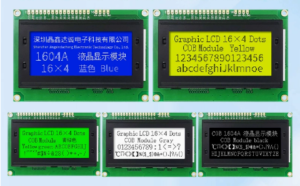
16×4 character COB LCD modules — more characters per line, same package logic as 1602 and 0802. Limitations: three things to settle before you specify
- Thickness. The die sits on the PCB, so the module is thicker than COG and FOG. If the enclosure sets a hard thickness limit at the display area, COB may be ruled out outright.
- Display density. COB fits character counts (8×2, 16×2, 16×4, 20×4) and low-to-mid density dot matrix (128×32, 128×64). Higher density and narrower bezels call for COG.
- Epoxy is temperature-sensitive. The compound’s temperature rating is set by its formulation. Wide-temperature projects (outdoor, automotive, industrial sites) must state the operating range in the specification and request high-temperature aged samples — do not source it as a room-temperature part.
Choosing by application: material recommendations

| Application | Glass | Backlight | Connector | Why |
|---|---|---|---|---|
| Industrial control instruments | STN, blue/white | LED backlight | Pins | Variable lighting; contrast plus backlight first |
| Home appliance panels | TN, yellow-green or black | None or low-cost LED | Pins or zebra | Cost-sensitive, mostly direct-read |
| Utility and energy meters | FSTN positive | None / optional | Pins | Wide temperature, readable in sunlight, long life first |
| Automotive displays | STN / VA | Per customer acceptance standard | Pins + FPC | Vibration and temperature dominate; verify against the end-product standard |
| Power tools | TN / STN | High-brightness LED | Pins | Heavy shock and vibration — where COB’s sealed die earns its keep |
| Weighing scales | STN / FSTN | LED backlight | Pins | Many large digits; contrast and viewing angle matter |
Where COB LCD modules are used: industrial control, appliances, automotive, metering, power tools and weighing equipment.
For automotive applications, temperature grades and vibration conditions follow the end product’s acceptance standard; the module supplier supports verification rather than issuing compliance conclusions.
What this means for buying: settle “where does the product sit, who reads it from how far, at what temperature” first — the material stack is the answer to those three questions, not a line item to pick off a price list.
Three selection mistakes
- Writing COB where COG belongs (or the reverse). The two differ in price, thickness and process; a spec typo here costs two rounds of quotation and sampling.
- Treating the epoxy as cosmetic. Black glue is the only mechanical protection for the bond wires. Check that appearance requirements do not compromise bond reliability before tightening them.
- Assuming a backlight is always clearer. A reflective positive display beats a backlit module in direct sunlight. Whether to add a backlight should follow the lighting environment, not a fuller-options instinct.
FAQ
What is the difference between COB and COG LCD modules?
COB bonds the die to the PCB and seals it under epoxy — thicker, cheaper, vibration-tolerant. COG bonds the die to the glass — thinner, higher graphic density, higher cost and process requirements. Choose by thickness budget and display complexity, not by which sounds better.
Why does the epoxy on a COB LCD module crack or yellow?
Sustained high temperature yellows the epoxy slowly; temperature cycling builds stress between epoxy, die and PCB, and a poor compound or curing process cracks it. State the operating range in the spec and request aged samples for wide-temperature projects.
Can a COB LCD module display graphics and custom symbols?
Yes. Character types (1602, 1604, 0802) display characters and digits; graphic dot-matrix types (128×64, 128×32) display pixel-based content including custom symbols and, with a font-ROM driver IC, Chinese characters. Write the intended content into the spec and let the supplier confirm the solution.
Should I choose TN or STN glass?
TN for low-segment direct reading at lower cost; STN for more segments, higher-duty driving, better contrast and angle; FSTN when a neutral black-and-white look matters. Glass type is fixed at tooling.
Specifying a COB LCD module for a new product? Channing LCD customizes character and graphic COB/COG modules — glass, backlight and connector combined to your enclosure — widely used in industrial control and metering equipment.
Send us the display content, character count or dot matrix, connector style and operating temperature, and we will confirm feasibility and quote within one business day: COB/COG LCD module products · Contact us.
