


01 | The Challenge: Bright Spots, Heat, and Assembly Difficulty
Client B is a manufacturer specializing in smart bathroom mirrors, with a main product line of makeup mirrors and bathroom mirrors featuring LED touch switches.
Their previous LGP supplier had three problems:
-
Insufficient light transmission: The LGP’s transmission was only ~80%, causing uneven brightness on touch keys and visible bright spots at the edges.
-
Noticeable heat: To compensate for low brightness, the client had to increase LED current, resulting in excessive heat around the LGP and reduced lifespan.
-
Difficult assembly: The previous LGP had no pre-applied adhesive, forcing the client to add an extra taping step with alignment risk.

02 | Our Action: From Optical Design to Assembly Process
After receiving the client’s samples, our optical engineers didn’t rush to quote. Instead, we performed a full optical analysis and assembly process evaluation:
-
Material issue: The previous LGP used standard PMMA with insufficient transmission and high light loss.
-
Optical design issue: Uneven dot pattern caused light leakage at the edges, forming bright spots.
-
Structural issue: The LGP thickness exceeded the design limit, preventing an ultra-thin integrated form factor.
-
Assembly issue: No pre-applied adhesive, requiring secondary processing on the production line.
03 | Our Solution: Imported LGP + 3M Integrated Adhesive + Full Custom Optical Design
We submitted a complete proposal:
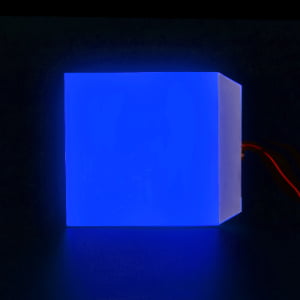
Material upgrade: Imported light guide plate with transmission up to 95% — about 15 percentage points higher than standard PMMA, delivering superior light efficiency.
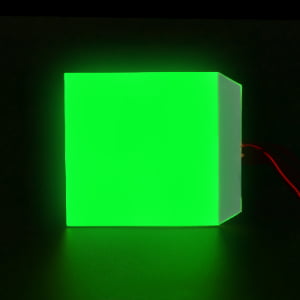
Optical optimization: 1-on-1 service from professional optical engineers, with a redesigned dot pattern to eliminate bright spots and ensure uniform illumination.
Structural optimization: Ultra-thin integrated structure with customizable thickness to match the client’s end-product design.
Assembly optimization: Pre-applied 3M double-sided tape with release paper on the back — peel and stick on the production line, eliminating secondary taping.
Full customization: Size, color temperature, shape, brightness, and interface all customizable, with free LGP optimization proposals.

04 | The Result & Value
The client accepted our proposal and completed sample approval within two weeks. Mass production validation showed:
-
Light transmission improved from ~80% to ≥95%, with uniform touch key illumination and no bright spots
-
Significantly reduced heat, with LED current back to normal levels and improved product lifespan
-
Reduced assembly labor; the client subsequently added 4 more mirror models to their LGP orders
-
16 years of manufacturing experience, direct source factory supply with stable lead times
05 | Conclusion
A good light guide plate isn’t just about “letting light through” — it’s about making light appear in the right place, at the right brightness, consistently.
Reference: Channing LCD internal case study. Client name anonymized.