


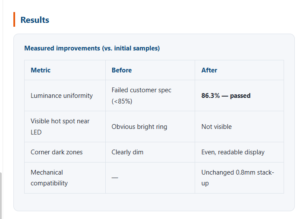
LED angle optimization and optical dot pattern redesign lifted luminance uniformity from 60% to 86.3% on a 0.8mm-thick edge-lit backlight, without changing the housing design.

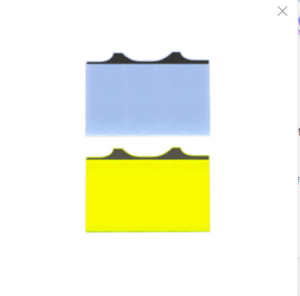
Actual 0.8mm ultra-thin backlight units: white mode (top) and yellow-green mode (bottom), customized for segment LCDs of blood pressure monitors.
Customer Background
Our customer is a European home-medical-device brand producing digital blood pressure monitors in volume. Their segment LCD module required an edge-lit LED backlight that fits into an extremely slim housing — the mechanical design allowed only 0.8mm of total backlight thickness, and the display had to stay clearly readable both in bright pharmacy lighting and at the bedside.
The Challenge
In the first engineering samples, the display showed a visible bright ring around the LED entrance and dark corners at the far edge — a classic symptom in ultra-thin edge-lit designs. measured luminance uniformity of 60% — well below the customer’s QA requirement of ≥85%.
At 0.8mm, the light guide plate (LGP) has almost no thickness to spread the light. Two coupled problems had to be solved at the same time:
.The LED light entered the thin LGP as a concentrated beam, creating a hot spot near the light source;
.The default optical dot pattern could not extract enough light toward the far corners, leaving the edges dim.
Our Solution
Rather than simply swapping LEDs or thickening the panel — which would have forced a housing redesign — we optimized the optical system from two directions:
.LED beam-angle adjustment. We re-selected the LED specification and adjusted the incidence angle so the light spreads deeper into the 0.8mm LGP instead of pooling near the entrance. This eliminated the bright ring effect at the source side.
.Optical dot pattern (LGP) re-engineering. We re-simulated and re-printed the dot gradient on the LGP surface, increasing extraction density progressively toward the far edge. Light that previously leaked out of the sides was redirected to the dim corners.
Both changes were made inside the existing 0.8mm stack-up, so the customer’s mechanical and assembly design remained untouched. After two iteration rounds of sampling and luminance mapping, the panel passed the customer’s inspection on the first formal submission.
Key Takeaway
Ultra-thin backlights below 1mm cannot rely on LGP thickness to homogenize light — uniformity must be engineered through LED incidence angle + dot pattern design working together. If your medical or instrument display is fighting uneven backlighting in a slim housing, this paired optimization is usually faster and cheaper than redesigning the enclosure.
“The display looks completely even now — no bright ring, no dark corners. And our housing didn’t change at all.” — Procurement engineer, European medical device brand (shared with permission, identity withheld)
Need a custom ultra-thin backlight for your device?
Send us your LCD dimensions and thickness limit – free optical simulation and
sample evaluation within 5 working days.
Get a Free Sample Evaluation