


Seven field failures — missing segments, blur, jumping digits, dead backlight, black screen, garbled text and certification holds — traced to three root causes and closed with a -40°C to +80°C UV-treated material set, a sealed 100,000-hour backlight and connector stack, and Holtek driver ICs.
|
7
Failure Modes Closed
|
-40~+80°C
Material Rating
|
100,000 h
Backlight LED Life
|
100%
Lit Tested Before Shipment
|
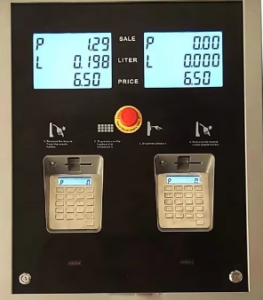
A fuel dispenser display is read by every driver at the pump — volume, unit price and total must be legible in direct sun, at night, and in sub-zero weather.
Customer Background
Our customer builds fuel dispensers in the United States for retail forecourt operators. Their machines stand outdoors all year — direct sun and high heat in the south, sub-zero mornings in the north — and run continuously next to pump motors, contactors and switching power supplies.
The LCD module is the customer-facing component of that machine. Volume, unit price and total are read at a glance by every driver, so a blank or unreadable screen is treated by the station as a pump outage. Because the enclosure, controller board and membrane keypad were already fixed, any replacement display had to be pin-to-pin in the existing mechanical stack-up.
What started as a component complaint ended up as a warranty and brand problem: rejected lots on their incoming-inspection line, plus field returns coming back through distributors.
The Challenge
Seven failure modes kept returning, from the field and from their own inspection line:
- Missing segments / strokes — characters partially black out, intermittent at first, permanent later.
- Blurry characters — soft edges and low contrast, unreadable a few metres away in sunlight.
- Digit jumping / unstable readout — values flicker or step while the pump motor runs.
- Backlight dead — the panel still drives, but nothing is visible at night.
- Black screen / no display — most often reported on cold starting.
- Garbled characters — random segments light up after electrical transients.
- Certification failure — the display blocks the dispenser from passing, holding the whole shipment.
- 100% lit test: zero missing segments or strokes on every unit — no sampling accepted.
- Cold start: full function and readable contrast at -30°C, with materials rated to -40°C.
- Heat soak: no contrast loss or segment dropout after 8 hours at +70°C, materials rated to +80°C.
- Backlight life: minimum 100,000 hours continuous, matched to dispenser service life.
- UV exposure: no yellowing or fading of polarizer and backlight films under long-term outdoor sun.
- Compliance: RoHS / REACH declarations complete, so the display never blocks the dispenser’s own certification.
Each of these is a pass/fail gate on incoming inspection. Missing one rejects the lot — which is why the answer could not be a component swap, and why the failure modes had to be traced back to their mechanisms first.
Our Solution
The seven symptoms reduce to three root causes: materials specified outside the real operating envelope, degradation at the light source and the connector interface, and drive configuration that does not match the host controller. We closed all three, inside the existing mechanical stack-up.
1 · Wide-temperature, fully UV-treated material set: -40°C to +80°C
Liquid crystal, polarizers, adhesive layers and backlight films are specified to the same -40°C to +80°C window. Every optical material in the stack is UV-treated, so the polarizer does not yellow and the backlight does not shift colour after years of direct sun. Contrast at +70°C stays where it was at room temperature, and the cell resists at -30°C instead of going sluggish or blank.
Why the conventional approach fails: most suppliers quote a standard industrial cell at -20°C to +70°C and then try to rescue cold starts with a heater film or a firmware delay. That adds power draw and an extra failure point to a sealed enclosure, while the liquid crystal itself is still outside its rated range — the black screen comes back on the coldest morning. Adding a UV-blocking cover glass does not solve the yellowing either the polarizer behind it degrades anyway. The only durable fix is to move the materials themselves inside the envelope.
2 · Sealed backlight and connector stack: 100,000-hour LEDs, waterproof anti-oxidation interface
The backlight uses LEDs rated for 100,000 hours of continuous operation, binned by brightness and colour so units match, driven current-limited rather than overdriven, and every module is lit-tested before shipment. Connector contacts are gold-plated with waterproof anti-oxidation treatment, heat-seal and FPC bonding pressure is controlled, and the module PCB is conformal-coated against humidity and sulphur.
Why the conventional approach fails: when segments start dropping out, the instinct is to change the panel, or the supplier. The failure is almost never the glass — it is contact resistance at the interface, driven by humidity and thermal cycling, and a new panel with the same connector design fails the same way. On the light side, pushing the existing LEDs harder buys brightness on the bench and accelerates lumen decay in the field, so the display dims long before the dispenser’s service life is over. Reliability has to come from the interface design and the LED rating, not from overdriving.
3 · Holtek driver IC, top-grade model, configured to your controller
We build with Holtek driver ICs in their top-grade models, with duty, bias and V0 matched to the host controller, plus ESD protection and an anti-interference layout on the module. One IC family is kept across a customer’s models, so behaviour is repeatable from sample to mass production.
Why the conventional approach fails: blurry characters, jumping digits and garbled text usually get “fixed” on the line by turning a contrast potentiometer or swapping in another driver board. That hides the symptom on the bench and lets it return in the field, because the real causes remain: a bias point set for the wrong multiplex rate, scan timing that couples with pump-motor noise, and IC batches that behave differently unit to unit.
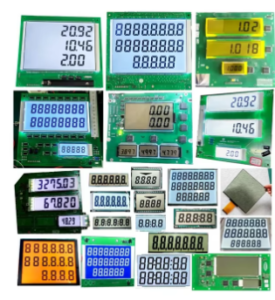
Fuel dispenser LCD modules in production: wide-temperature cells, UV-treated optics and sealed connector interfaces, built as pin-to-pin replacements.
All three changes live inside the original footprint. No enclosure modification, no new controller firmware, no change to the keypad harness — the customer’s mechanical and certification work stays valid.
Results
| Field failure | Countermeasure | Outcome |
|---|---|---|
| Missing segments / strokes | Gold-plated sealed contacts, controlled bonding pressure, conformal coating | Stable contact resistance; no intermittent strokes |
| Blurry characters | Holtek IC with correct duty/bias + matched polarizer | Sharp, high-contrast characters at a few metres |
| Digit jumping / unstable readout | Stable scan timing + anti-interference layout + ESD protection | Readings steady with pumps and motors running |
| Backlight dead | 100,000-hour binned LEDs, current-limited drive, 100% lit test | No dead-on-arrival backlights; life matched to service life |
| Black screen / no display | -40°C to +80°C material set | Cold start and heat soak stay inside rated range |
| Garbled characters | Holtek IC + ESD protection + conformal coating | No register corruption after electrical transients |
| Certification failure | RoHS / REACH materials, ISO 9001 process, documentation support | Display no longer blocks dispenser certification |
Read the table top to bottom and the pattern is clear: every symptom is closed at its mechanism, not at its appearance. None of the seven fixes ask the customer to change the enclosure, the controller or the wiring harness — the module drops into the dispenser that already exists.
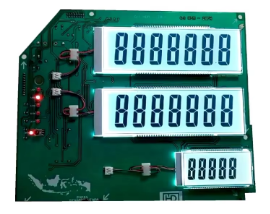
Every module is powered and lit-tested before packing — 100% inspection, not sampling.
What the Customer Gets
A display that clears incoming inspection on the first submission, plus the material declarations their certification team needs. Related work: sunlight-readable motorcycle dashboard LCD (+35% clarity) and 0.8mm ultra-thin backlight for blood pressure monitors (60% → 86.3% uniformity). Built on our custom segment LCD and COB LCD module platforms, for industrial control and metering equipment.
“The display has stopped being the reason a dispenser fails inspection. That is all we needed from this component.” — Quality engineer, US fuel dispenser manufacturer (shared with permission, identity withheld)
Stop treating display failures as warranty cost.
Send your current dispenser LCD drawing, or one failed sample. You get a pin-to-pin improvement proposal within 24 hours, and a sample in 3 days after drawing confirmation.